What makes the Most Expensivest edit funny
Speed is not the secret: every episode cuts about 27 times a minute and switches the music on and off about as often. What the praised episodes share is the series' later style (2017 on): a second comic voice in the edit that answers what was just said with graphics, inserts and callbacks (about 2 to 4 added jokes a minute, vs about 1 in 2014-16), replayed and borrowed reactions, less talk and longer music breaks. Low-praise episodes from the same later years use the same toolkit, so it is the house style, not a guarantee of praise.
Your five points, answered
Making something out of nothing
The edit acts like a second comic voice. About two in three added jokes answer something just said, usually right after it: it takes words literally, prints the exact word, talks back in straight-faced text, and brings gags back with a twist. The later episodes (2017 on) run about 2 to 4 added jokes a minute, the 2014-16 ones about 1.
The full answer
About two in three added jokes answer something just said, usually right after it. Edit-made gags run about 2-4 per minute from 2017 on (praised and low-praise alike) vs about 1 in 2014-16, and the groups overlap: the exact rate depends on what you count as a gag, so never use one number as a target. Six engines make something from nothing: take the word literally (31 of 35), print the exact word (32), let the show's straight text talk back (26), repackage a dull stretch as another format (30), cast someone in a role (18) and pay things off with callbacks (31). The seventh is subtraction: pull the music and hold the face, as in the 12.4 s of stares with no music around 'big thick book' (5033 likes), though those comments quote the moment rather than credit the edit. The biggest comments that do credit the editor go to additions, led by the sad-man runner ('lmaoooo the editor did that man so dirty', 26245 likes). When the room is really funny the edit adds nothing (the FedEx laugh, a 4.42 s wide, 2149 likes). Gags cannot fill a payoff the footage lacks: the coat never goes on the dog in Dog Fur Coat, and that is the top complaint.
Reactions
You're right about the splicing. At least 1 in 10 to 1 in 14 reactions can be proven replayed or borrowed, and the rest look real, though that can't be proven. Real ones land right after the line and hold 1 to 3 s. How often they cut to a reaction doesn't separate praised from low-praise episodes. Spliced reactions show up in the later style, low-praise episodes included, and none were confirmed in 2014-16.
The full answer
At least 1 in 10 to 1 in 14 reactions can be proven replayed or borrowed; the rest look real, but that cannot be proven. Helpers logged 722 reaction cutaways in the 35 praised episodes and flagged 69 as spliced, about 1 in 10, against 64 cutaways and none confirmed in the 2014-16 controls; an audit of one batch upheld only 7 of 10 flags, and most cutaways cannot be proven real time either, so read 1 in 10 as rough. Frame-confirmed non-real-time reactions appear in 23 of 35 praised episodes, and none could be proven in the other 12. There are two routes: the same footage twice (15 episodes, each return shorter, or a stock answer replayed 26 s later) and a look borrowed from another moment or shoot (11 episodes, 1.0-2.5 s, glued by one music track). Real reactions arrive 0-0.5 s after the last syllable, or 0.08-0.4 s before the trigger word, and hold 1-3 s, up to 5.88 s for an episode's biggest. Back-and-forth runs one line per shot at 0.33-2.2 s. Neither the rate of reaction cutaways (3.63 vs 2.33 per minute) nor splicing separates praised from low-praise: the 4 low-praise 2017-23 episodes splice at the same rate, and 2 of them reuse the same frames. Splices get caught and cost trust: 'Don't know what reaction is real and what is not' (435 likes), and viewers may have read borrowed faces as real contempt (421 likes).
Conversation pacing
It isn't speed. Every group runs about 24 to 28 cuts a minute, and ours run 31 to 35. The later style has more room: someone is talking about 72% of the time vs 81% in 2014-16, and 85 to 91% in ours. They trim information and keep reactions: 1 to 3 s on a silent face, 3 to 13 s for an awkward silence.
The full answer
Trim the information, keep the reaction. Speed explains nothing: 27.2 vs 27.6 cuts per minute, and within the praised set cut rate does not track editor comments. The later style leaves more room: someone is talking 74% of the runtime in praised episodes vs 81% in 2014-16 ones, but 72% in the low-praise 2017-23 ones, so it is house style, not a praise signal; ours run 85-91% in our two HafuGo videos, which already cut faster at 31-35 cuts per minute. Holds run 1-3 s on a silent face, 1.5-2.9 s after a one-word answer, 3-13 s for an awkward silence and 4-12 s for an uncut bit. Cutting does not stop in the silence: median shots inside dry stretches run about 1.8-2.0 s against about 1.75 s elsewhere. Trims hide under angle changes every 1-4 s and 0.8 s listener cutaways, in controls too. Sincere beats get the reverse: about 4.1 s shots vs 2.4 s, and no tools.
Scene changes
Mostly no on b-roll cut to the beat. Across 441 no-dialogue cuts and 240 music stretches, the timing matches random cutting, so it isn't a house habit. Some runs do lock (the Funk Instruments jam on the bar, the Party Planner itinerary), which may be what you noticed, along with new music landing on a picture cut twice as often as chance. The test can't see a lock on fewer than about 1 cut in 5, and nobody listened. J-cuts are real but local (0.35 vs 0.20 a minute).
The full answer
Sound carries scene changes, on mostly hard cuts: the old cue drops on the last line, 0.2-3 s of gap, and a new cue hits the first cut of the new topic. B-roll is mostly not cut to the beat as a habit: 25.6% of 441 b-roll cuts sit within 50 ms of a music onset vs 28.3% by chance, and every episode-wide test is at chance, so runs on the beat are local (Funk Instruments' jam locks to the bar, Party Planner's itinerary), and the test cannot see locks on fewer than about 1 cut in 5. What is locked to the cut is music level: new music enters on a picture cut 28.7% of the time vs 13.5% random, and stops 23.7% vs 14.4%, in controls too, and most entrances still miss the cut. Dialogue J-cuts are the one transition the counters separate (0.35 vs 0.20 per minute): 0.2-0.9 s inside exchanges, 0.5-2.5 s out of bio cards, up to 5.8 s into a chapter. Helpers saw music pre-laps as praised-only, but the meter disagrees: hard entrances land 0.25-1.0 s before a cut at the same share in praised and controls (25% vs 26%), no higher than random times (29%). Inserts end on hard cuts with their music dead within 0.1-0.4 s, so the next line lands dry. Picture effects (whip blur, white flash, VHS static, paint or smoke wipes) mostly launch sequences or end cards, and a cold open with a teaser, montage or gag is house style (25 of 35, all 5 controls); those previews are not counted as callbacks. The fake 'we'll be right back' break appears in one episode of 40.
Music
You're right, but the switching is in every episode: about 3 hard stops a minute in both groups. What changed in the later style is how long the music stays out: the longest dry stretch runs about 14 s, vs 8 s in 2014-16. Stops follow picture cuts more than line endings, so 'stop on the joke' describes the moments they choose, not the average stop.
The full answer
Music is a switch in every episode, controls included: hard stops run 2.75 vs 3.19 per minute and hits 3.75 vs 4.53, and stops used as punctuation 1.54 vs 0.97, so how often it switches does not earn the praise. Stops are locked to picture cuts but only weakly to line endings (28.2% vs 24.1%), and they fall under talk at about chance, so 'stop on the joke' describes chosen moments, not the average stop. What changed between the 2014-16 style and the later one is how long it stays out: music covers 73% of runtime vs 83%, and the longest music-free stretch has a median of 14.1 s vs 7.9 s. That is house style, not what earns praise: the 4 low-praise episodes from 2017-23 run even drier (music on 47%, longest break 30 s). 27 of 35 praised reach 10 s against 1 of 5 controls (a dry cold open), and 15 reach 16 s against none. Across the five controls the longest stretch runs 6.7-12.4 s. The usual moves are a hole of 0.2-3 s under one line, a kill of 3-30 s for a bit, a slam of +15 to +37 dB on the release cut, and a new cue per bit that dies on the cut out. There is no single rule: Japanese Whiskey raises music into a silence and Vintage Sunglasses slams it on the punchline. Music share falls with era (84% up to 2016, 72% from 2017), and moods in these notes were read from levels and picture, not heard.
Ours next to theirs
Same meters, run on two of our long-form videos. We already cut faster than they do, and our music breaks are as long. What we lack is room between the talking, and added jokes.
| Our Snacks | Our School Hacks | Praised episodes | Low-praise, 2017-23 | Low-praise, 2014-16 | |
|---|---|---|---|---|---|
| Cuts per minute | 31 | 35 | 27 | 24 | 28 |
| Runtime with someone talking | 85% | 91% | 74% | 72% | 81% |
| Runtime with music | 75% | 83% | 73% | 47% | 83% |
| Hard music stops per minute | 2.1 | 1.7 | 2.75 | 2.8 | 3.2 |
| Longest music-free stretch | 16.5 s | 43 s | 14 s | 30 s | 8 s |
| Added jokes per minute | 0.7 to 1.8 (Snacks tasting) | about 2 to 4 | about 3 | about 1 | |
In the 6-minute tasting stretch of Snacks (9:12 to 15:12), on one reviewer's count:
| Per minute | Snacks tasting | Praised episodes |
|---|---|---|
| Cuts to one person listening | 0.3 to 0.8 | 3.6 |
| Jokes added in the edit | 0.7 to 1.8 | about 2 to 4 |
| Reactions taken from another moment | 0 | about 0.15 to 0.23 |
| Music stops used as punctuation | 1.7 | 1.5 |
This isn't like for like. About 4 of 5 Snacks shots already show both people, while Most Expensivest is shot as singles. So the listener is visible; what's missing is a big isolated face, and that is partly a shooting choice, not an editing one. The reviewer also knew what we were looking for, and this is one stretch of one video.
The moves that define the later style
Ranked by how much more the praised episodes use them than the 2014-16 ones. The 4 low-praise episodes from 2017-23 use 5 to 8 of these 8 moves each, so read this as the house toolkit, not a list of what earns praise. Each card says whether our rules allow it today.
1. Callback with a twist
An earlier line, gag, shot or graphic returns later with one thing changed, so the second time pays on recognition. Counted only when the edit builds it: a host repeating himself, or a cold-open preview, does not count.
Blocked today: our law AX cuts editor-added callbacks. Your call 2.
How to do it, and where to watch it
- Log plants while assembling: a bio-card line, a buzzword, a prop, a gag's first look.
- Bring it back on a matching trigger (the next 'Woo!', the same price).
- Change one thing each return: a new grade, an added line, a longer hold.
- Close the episode on one if you can.
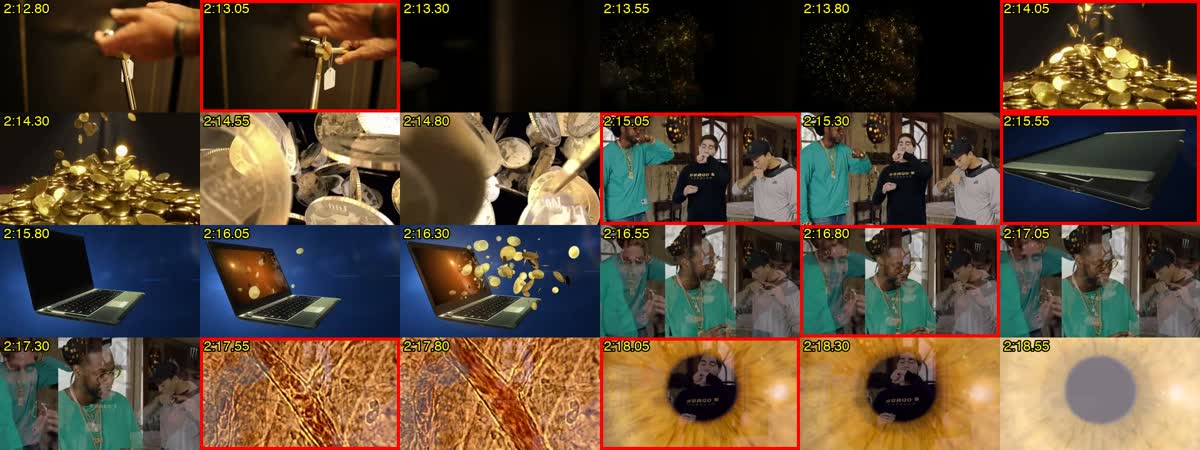
- IV Drip 2:13.6: A hashtag of the CEO's own buzzword sits on the wide as he cups the lighter, 37 s after he said it. "Bro really blocked the wind for 2 chainz 😂. That is a1 hospitality lol (5532 likes)"
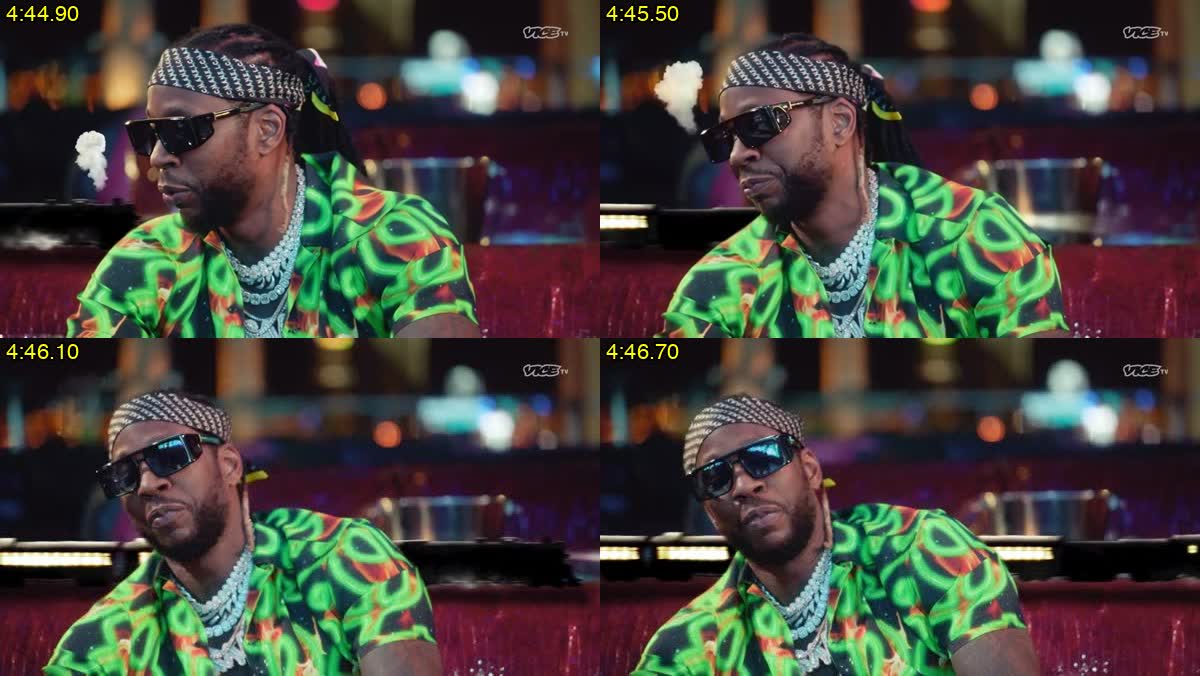
- Vegas Club 4:44.7: The composited train from 1:07 rolls back through behind him on his first 'Woo!' after the sip. "Everytime he says whoo the train passes by 😂😂 (0 likes)"
- Super Yacht 6:27.1: A 16 s finale rebuilds earlier gags (shark, slide, bow, fist bump) with new absurd elements. "Lmao the editor snapped 😂😂 (531 likes)"
2. Print the exact word
Big burned-in text spells what was actually said, tics, stumbles and mangled words included, so a mumble becomes a written joke.
Usable today, as long as the text is his exact word.
How to do it, and where to watch it
- Pick the word with personality: a filler, a mispronunciation, a coined word, a catchphrase.
- Bold caps, one word or syllable per spoken onset, 0.2-0.7 s apart, spelled the way it sounds.
- On a repeat, change it: reset on the other speaker's shot, scale up, add punctuation.
- Hold to the next cut, or carry it across one cut; clear it on a wide.
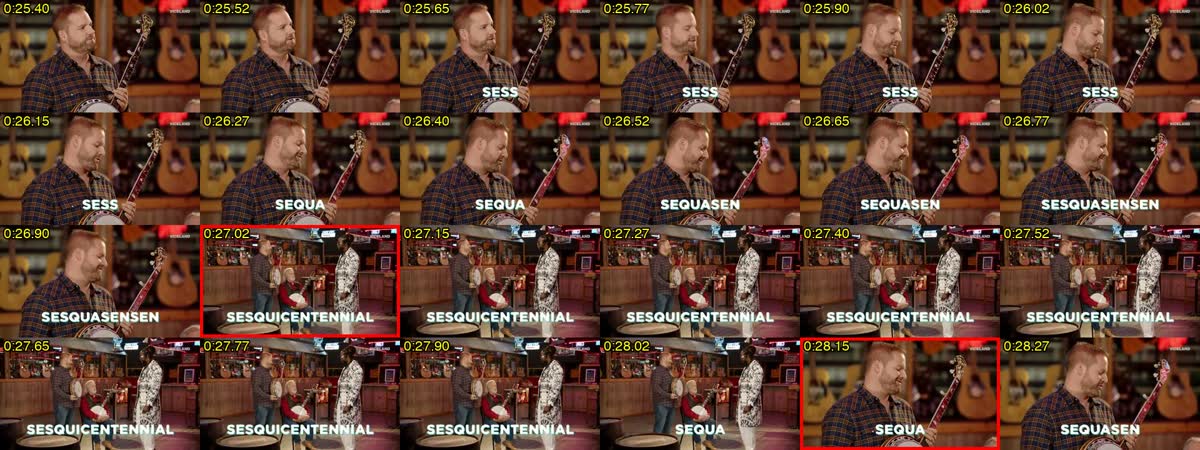
- $22K Banjo 0:25.6: Text spells each failed attempt (SESS, SEQUASEN), flips to the right spelling on the correction, then rebuilds. "That dude who messed up “sesquicentennial” is out looking for a new job after old dude fired him. (1859 likes)"
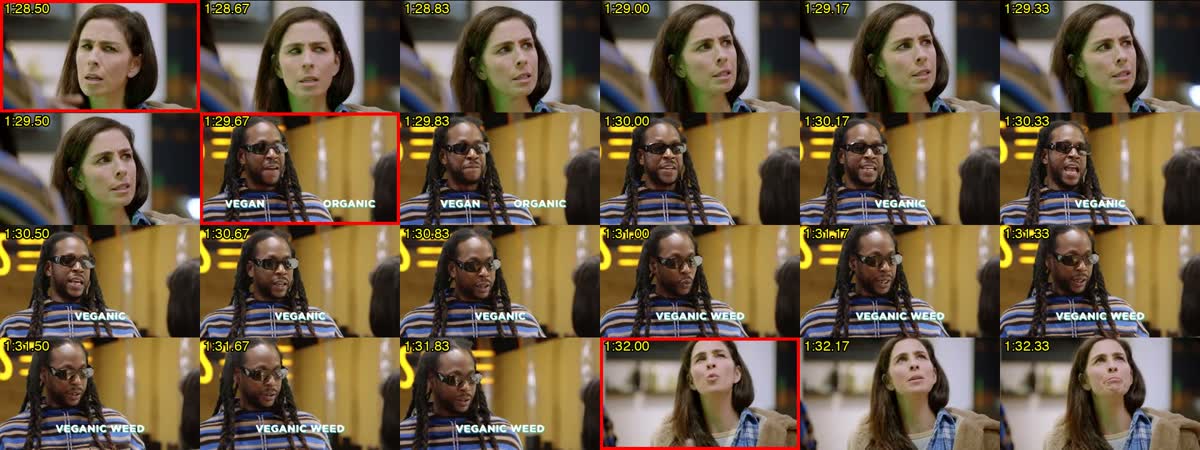
- Marijuana with Sarah Silverman 1:17.4: 'VEGAN' and 'ORGANIC' pop on his words, then slam together into 'VEGANIC WEED'. "Veganic weed sounds like the biggest gimmick ever 🤣🤣🤣 (6166 likes)"
- Retirement Home 0:27.0: The chef's pitch stacks word by word and '+CERTAINLY' lands as the last line, tagging his tic. "“Of course” “Certainly” “Absolutely” “Certainly” Few words can get you far in life (3622 likes)"
3. Joke line in the ID card
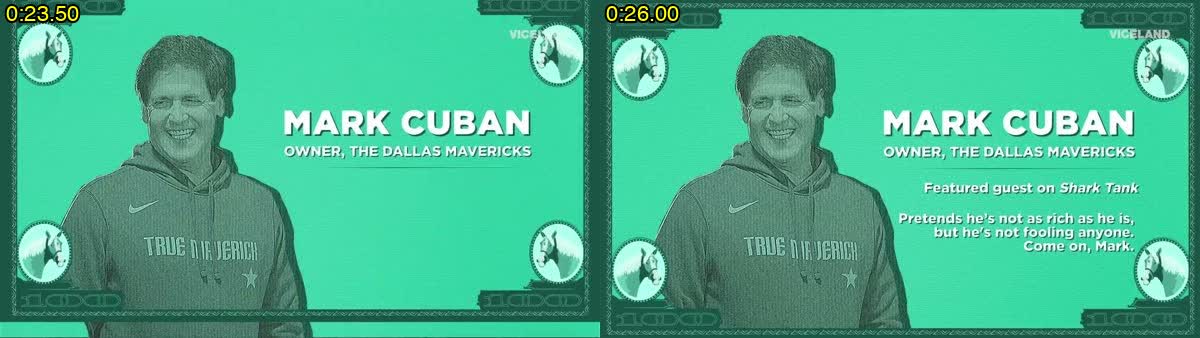
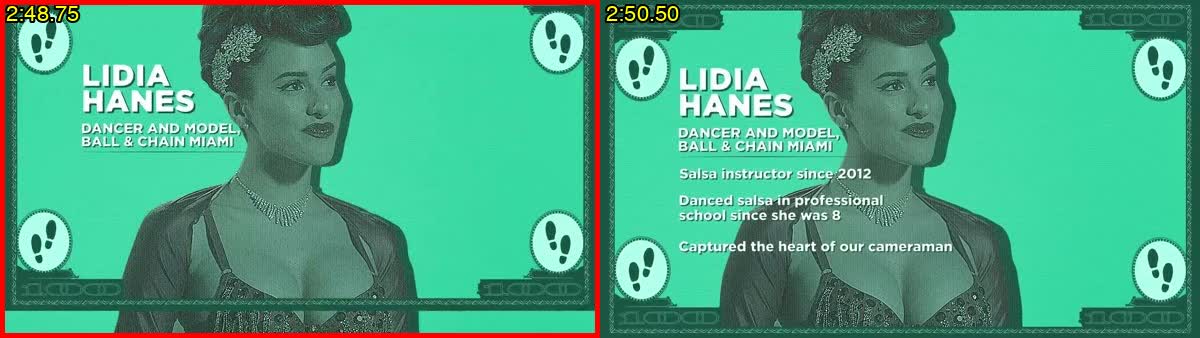
An official-looking ID card or lower third types real credentials, then ends on a joke in the same straight design. None of the 2014-16 episodes has a joke line in a card, nor do the 3 praised 2016 episodes, but 2 of the 4 low-praise 2017-23 episodes do (Choppers, Sex Dolls): a later house style.
Blocked today: our law BB bans caption-writer jokes. Your call 2.
How to do it, and where to watch it
- Freeze the handshake or first pose and tint it (green or teal halftone, money-bill frame).
- Slide the card in over 0.2-0.6 s just after the line ends.
- Type real facts 0.25-1 s apart, then the joke line last, 1-3 s after the card lands.
- Hold 6-7.5 s on its own music with nobody talking.
- Start the next line 0.4-2.5 s under the card (a J-cut), then wipe it off.
- Horses with Mark Cuban 0:22.7: Dollar-bill card: owner, Shark Tank guest, then the roast line, held 7.3 s. "“Pretends he’s not as rich as he is but he’s not fooling anyone” 🤣🤣🤣🤣 (1009 likes)"
- Salsa Lesson 2:43.5: Real dance credentials type on; the last line is 'Captured the heart of our cameraman'. "2:50 “captured the heart of our cameraman” im dead yo (133 likes)"
- Hendrix Jacket 0:22.4: The dog gets the guests' card, with the single credential 'Good boy'. "Trappy is a good boy (81 likes)"
4. Long no-music stretch
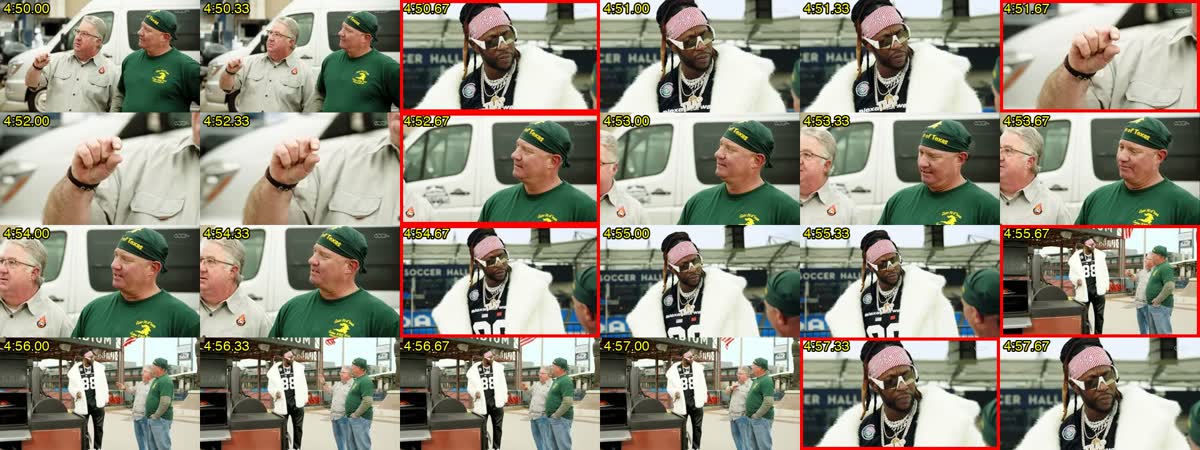
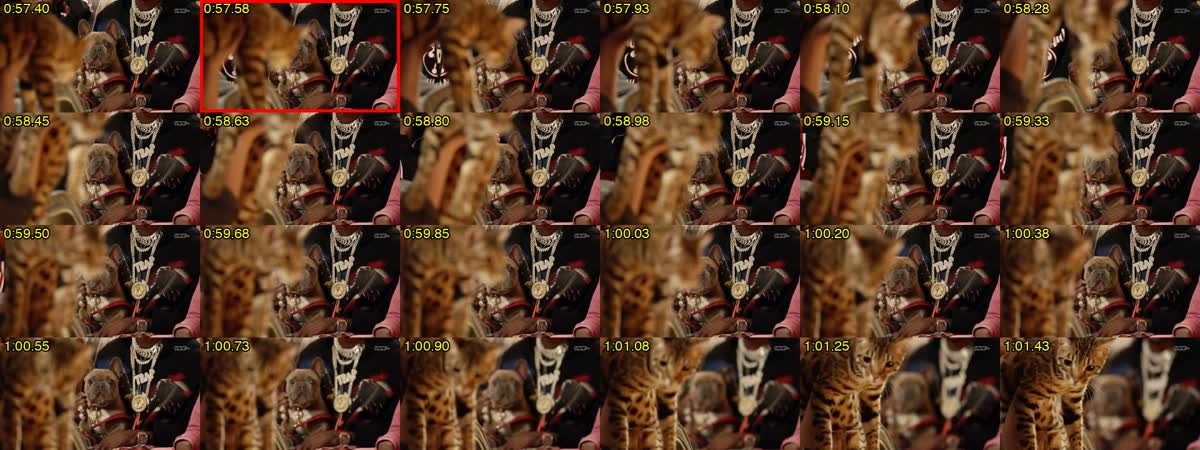
Music stays out 10 s or more through a ritual, confrontation or awkward beat, so the scene reads as unmanipulated and the next entrance hits harder. Metered on all 44, cold opens included. Longest music-free stretch: praised median 14.1 s (middle half 10.8-24.5 s, top 55.7 s), controls 6.7-12.4 s (median 7.9 s). 15 praised reach 16 s, no 2014-16 episode does (the one over 10 s is a dry cold open); all 4 low-praise 2017-23 episodes reach 10 s and 3 reach 16 s.
Mostly usable. Our music rule (80% or more) limits it. Your call 1.
How to do it, and where to watch it
- Pull the music before the scene or on the cut into it.
- Keep it out for the whole thing, carried by room tone, the lines and held faces.
- Do not sneak music back in during the squirm.
- Return only on the release (a laugh, the next business line, a new location), often as a new cue.
- Grill 4:48.7: 12.4 s with no music after 'a big thick book': 10 shots of stares and a punch-in on his pinched fingers. "“And they get a big thick book” “””silence”””” “over 60 pages” 😶😶😂😂😂 (5033 likes)"
- JFK Hotel 5:32.1: No music for about 50 s through the complaint, a 14.27 s answer and the rant; back only on the location change. "the anti-karen rant was pure gold (2521 likes)"
- Vegas Club 3:13.2: A loud 14.9 s music-video parade, then a hard cut to the real-time wide with the music gone. "So awkward without music lol (2370 likes)"
5. Parody cutaway, own music
Stop the scene for a self-contained cutaway in another format (cartoon, movie spoof, game show, news, drug-film montage, trailer) that acts out a throwaway line and tops it. Includes 'trip' inserts that show how the product feels.
Usable today in long-form, inside our music genre rules. Costs a real asset per insert.
How to do it, and where to watch it
- Pick a line that fits a format: a named film, an idiom, a story with no pictures, a dead stretch.
- Pull the music 1.3-3.1 s under the setup and hold a silent face.
- Hard-cut on the last word; the insert's own cue hits on frame one.
- One shot per clause (0.5-2.3 s); escalate past what was said and end on a twist.
- Leave by a hard cut or style break, kill the cue within 0.1-0.4 s, land on a real silent face.
- $450K Tequila 4:21.4: After 'Was it like a myth?' and 2.09 s of silent stares, a 34 s pirate cartoon with its own score. "Yo these edits are sick man🤣🤣🤣 That Pirate treasure hunting had me dead💀🤣🤣 (2203 likes)"
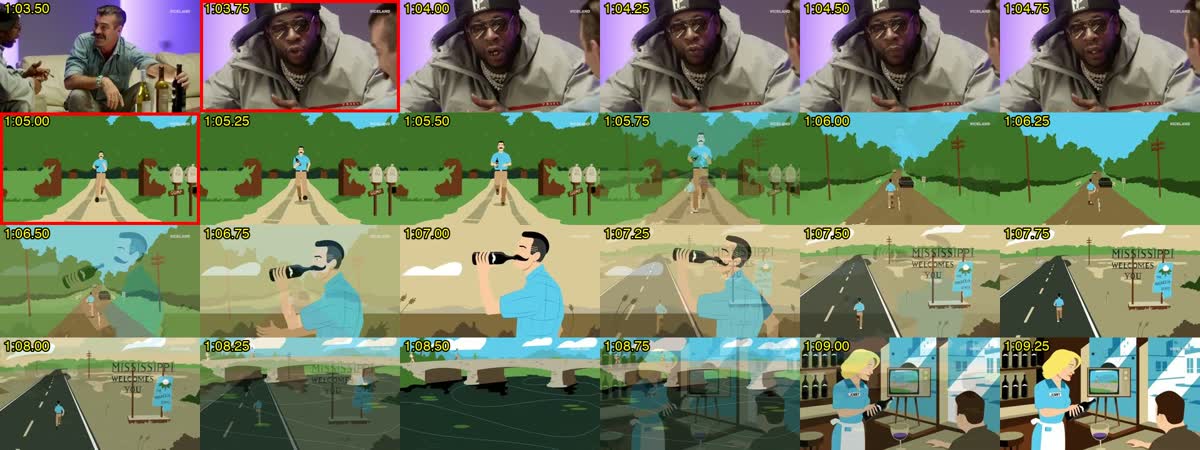
- Lowriders 5:42.7: His 60 s party story dissolves into flat animation, his live voice as VO, every noun drawn on the word. "GQ, don’t EVER replace the animators and editors they’re too fire (2878 likes)"
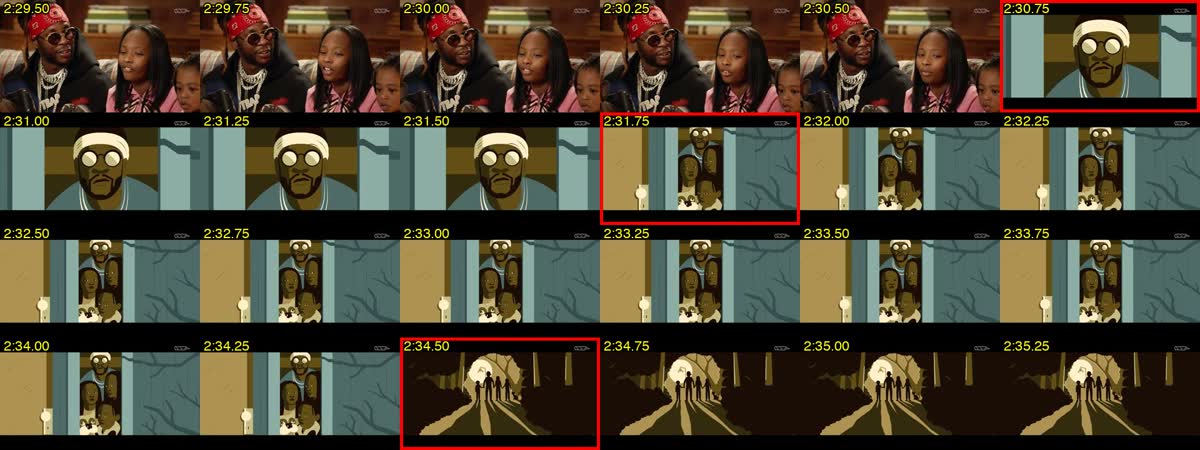
- Cloned Cat 2:30.7: The clone question gets no answer: hard cut into an 'Us' cartoon of the family, then her silent face. "Notice how she never answered her question about coning humans, or she did but they just edited it out. (111 likes)"
6. Price graphic with a twist
A spoken price becomes a designed beat: a burst or splat on the number, carried onto the listener's face, usually with a twist nobody said. Counted only with a burst or a twist; plain numbers do not count (all 5 controls have those, as do $350K Gun and Gold Popcorn), which leaves 2 controls with a twist or running total.
Partly: a graphic is fine, a joke line in the text falls under law BB. Your call 2.
How to do it, and where to watch it
- On the number fire a smoke puff or splat (0.3-0.5 s) that clears to big text with a small label.
- Carry it across the cut onto the listener's silent face.
- Twist it once: a parenthetical ('$2 MILLION (FOR A CLOCK)'), running maths, a rewrite ('1x NURSE = $1,000'), an added cost ('+ SALES TAX').
- For the big number pull the music 1-3 s before and bring it back on the card.
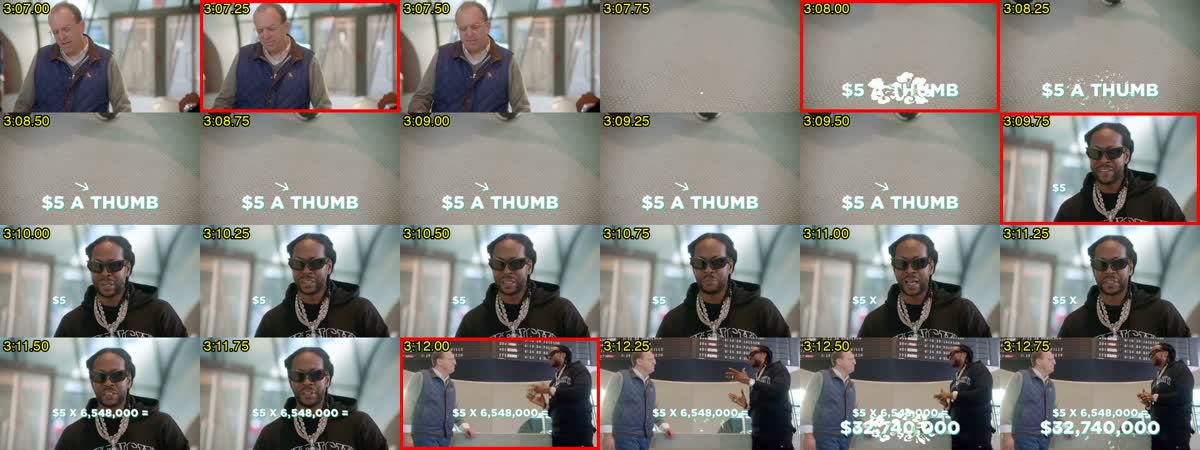
- JFK Hotel 3:07.1: '$5 A THUMB' bursts in, the sum types on with his words, '$32,740,000' puffs in, across 3 shots. "So unless I heard that wrong, the floor is more expensive than the power plant?? 🤯 (289 likes)"
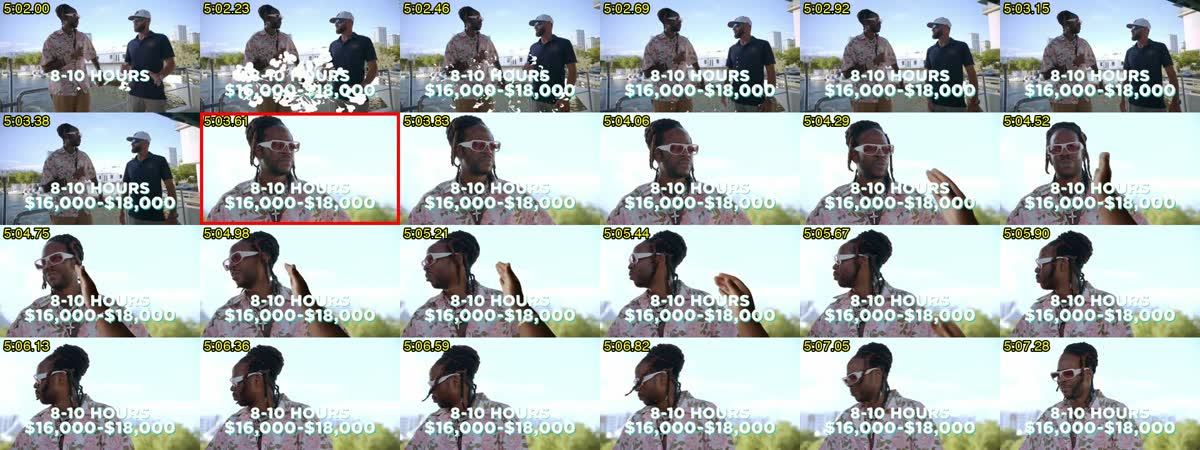
- Super Yacht 5:02.1: The price rides onto his close-up and a composited hand slaps him, so cause and hit share the frame. "Dat slap once he said 16/18k had me cryin 😂😂 (2 likes)"
- Robot Dog 1:08.8: Music out 2.4 s, then a +35.7 dB slam and a smoke burst clear to '$2,899.99 / AIBO'. "2 Chainz: so how much is it again? Her: $2899 2 Chainz: ma headband cost that money (82 likes)"
7. Reuse the same reaction
The identical frames of a reaction appear twice or more, to stretch a pause, build a chant, double a laugh or answer a later line, including a return from an insert on the same take. Frame-confirmed only; none confirmed in 2014-16, but 2 of the 4 low-praise 2017-23 episodes do it too.
Blocked today: law AO and the footage-reuse check stop the same shot twice. Your call 2.
How to do it, and where to watch it
- Take a 0.75-3 s reaction or reply clip and pull the music.
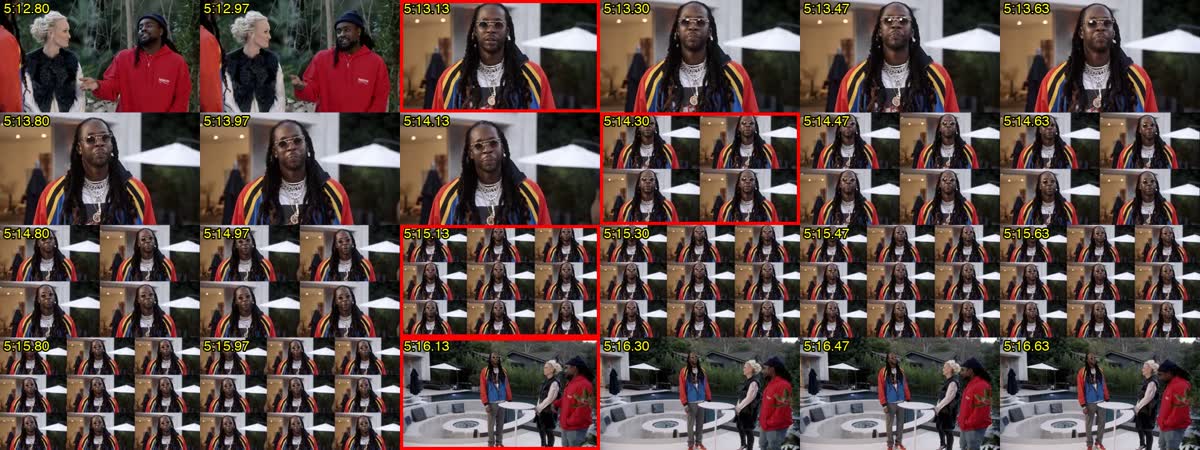
- Re-insert it between the other person's lines, each return shorter (3.15, 1.42, 1.25, 0.33 s), or reuse a stock answer 26-53 s later.
- Hidden: under about 0.8 s, or buried in a fast run. Open: repeat it exactly and let the music run.
- Around an insert: 1-1.6 s of the face before, 1-2 s of the same take after.
- Retirement Home 4:24.8: Asked 'What is that?' again, the same chef close-up from 3:58.7 replays 'It's delicious', music left running. "Lol. "What is this??" Chef:"its delicious" (2238 likes)"
- Foam Clouds 3:16.1: One deadpan and one guest shot are each used twice under 'A couple hours?' and '30 minutes?'. "3:17 “Could you do this all day?” 😶 “Couple hours?” 😶 “30 mins?” 🤔😏 ‘it’s na bad’ (358 likes)"
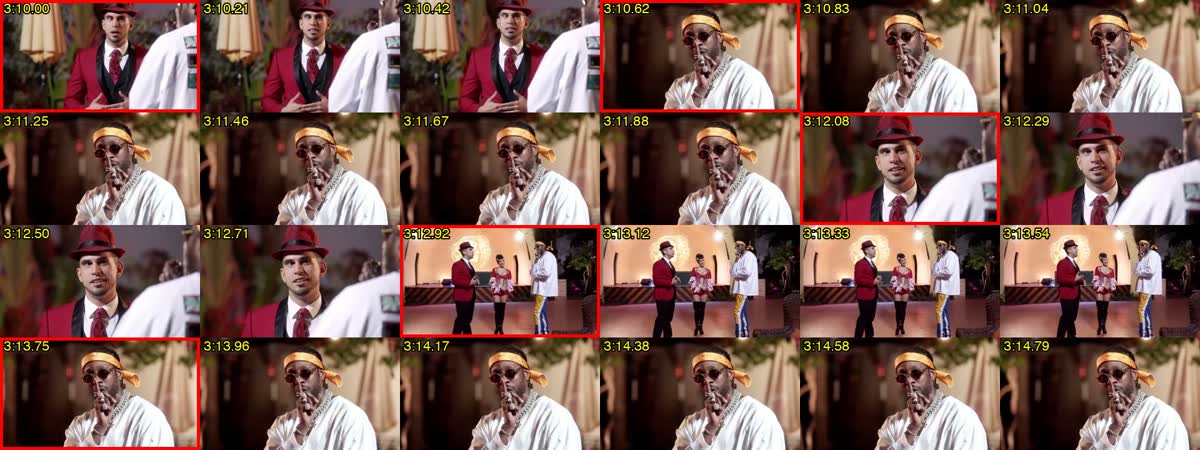
- Salsa Lesson 3:03.9: His real 3.15 s shush, then the same frames return at 3:10.6, 3:13.7 and 3:21.2, each shorter. "SHHHHH! (7 likes)"
8. Dry one-line volley
A short exchange cut one line or one silent face per shot with the music stripped, so three words play like a sitcom beat. Counted only when the exchange runs dry: 5 helper-logged cases on music are excluded, the one control case is $295 Burger's caviar exchange (1:43.8), and cold-open teasers do not count on either side. A rough meter (4 or more shots of 2.5 s or less inside a music-free stretch) gives 25 vs 0 and matches 19 of the 21, but random placement predicts 26 and 2, so it is support, not proof. None of the 3 praised 2016 episodes has it.
Usable today, where the footage has singles of both people.
How to do it, and where to watch it
- Strip the music on the first line, or within about 0.1 s of a deflating line.
- One line per single, cut at the line end: 0.33-0.8 s for a one-word reply, 1.5-2.2 s for a question.
- Silent version: alternate silent faces, each shorter than the last (2.4, 2.3, 1.2, 1.1 s), 3-5 cuts.
- Button on a 1.6-2.5 s held face or a laugh; music back on the cut that changes subject.
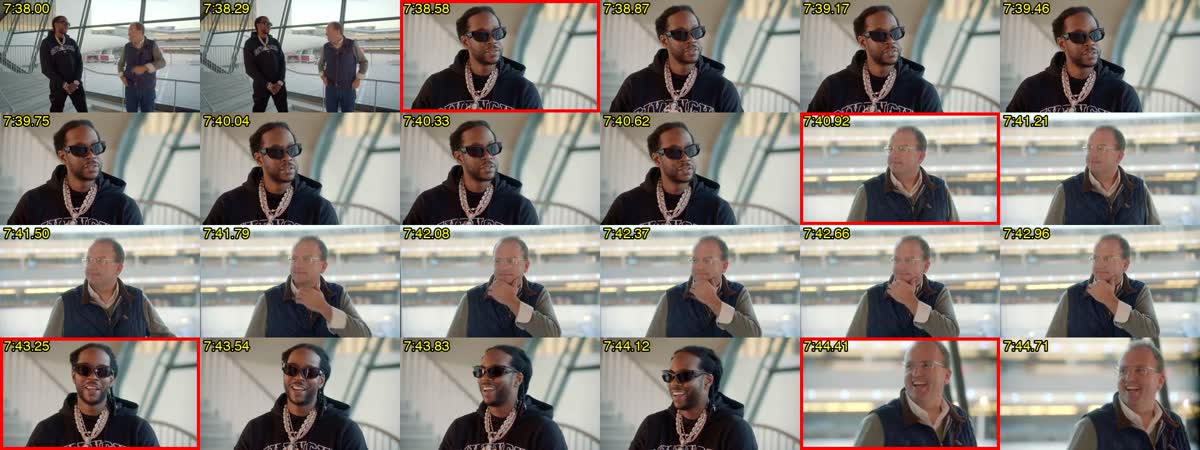
- JFK Hotel 7:33.1: After 'Those are your peeps' the music drops and silent close-ups alternate (2.38, 2.25, 1.21, 1.08 s). ""THOSE ARE YOUR PEEPS" TOOK ME OUT! (2968 likes)"
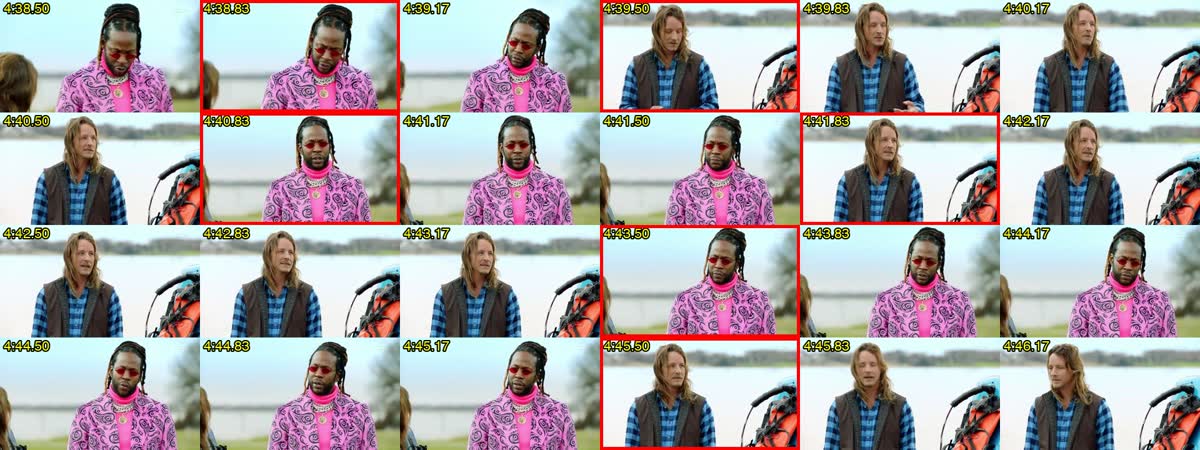
- Motorized Surfboard 4:38.5: Music drops on 'I want one'; one line per close-up, 'Nice' held 1.50 s, ending on a 1.6 s silent stare. "“I got a lake at the crib”......”Nice” (1938 likes)"
- $22K Banjo 3:58.8: Six shots in 6.8 s, dialogue dry: the question, her quiet 'Clogging', his loud 'CLOGGING', a laugh, a smile. ""what yall call it?" "cloggi-" "CLOGGING" (9 likes)"
The other 23 techniques
| Technique | What it is | Episodes | Our rules today |
|---|---|---|---|
| Every bit gets its own music | A gag or insert gets its own cue, switched on at the cut in and dead at the cut out, so music marks where a bit starts and ends. Control cases are single stings inside one gag. | 27 of 35, 2 of 5 from 2014-16 | Usable |
| The edit talks back in straight-faced text | The show's own factual graphics (footnotes, labels, hashtags, definitions, data graphics, a narrator) deliver a line nobody said, in the same flat register as the real information. Control uses are one mild case each. | 26 of 35, 2 of 5 from 2014-16 | Blocked: law BB (your call 2) |
| Music that says the opposite of the picture | A cue with the wrong weight for the moment: horror under a stare, a trailer for a late guest, hype for a zipper. Helpers could not listen, so moods are read from level, tempo and picture. | 19 of 35, 1 of 5 from 2014-16 | Only inside our music genre rules |
| Comedy punch-in | A jump to a tighter crop of the same take, or a fast push, on a face or gesture inside a silence or on a last word, to escalate a look. | 19 of 35, 1 of 5 from 2014-16 | Usable |
| Build the music, drop it on the verdict | The music rises under a silent card, wait or stare, then dips or stops on the verdict. Group B named it; a scan added 5 episodes, so this is a floor. | 12 of 35, 0 of 5 from 2014-16 | Usable |
| Cast someone in a recurring role | One person, animal or object gets a recurring role through one repeated device (a grade, a cue, a card, a reaction slot), planted early and paid off. | 18 of 35, 1 of 5 from 2014-16 | Only if the person would laugh too |
| Borrow a reaction from another moment | A look from a different moment, setup or shoot (not the same footage twice) is cut in as if it answered the line. Proven by continuity on frames; none confirmed in 2014-16; 1 of the 4 low-praise 2017-23 episodes does it (Funeral 4:18.3, a laugh from another room). For us: same scene only. | 11 of 35, 0 of 5 from 2014-16 | Same scene only, other angle or take |
| Take the word literally | The literal or wrong meaning of a spoken word goes on screen on that word: composited into the shot, or a hard cut to a 1-3 s insert. Presence ranking undersells it: control cases are single or informational, while dense praised tours land one every 9-25 s. | 31 of 35, 3 of 5 from 2014-16 | Usable |
| Put the joke on the listener's face | The graphic or grade goes on the silent listener, not on b-roll, so the reaction shot is the punchline. Named by groups A and D; a scan added 7 episodes, so this is a floor. | 16 of 35, 1 of 5 from 2014-16 | Usable |
| Cut to the picture that contradicts the line | On a claim, cut to what contradicts it: a gesture, a yawn, the wrong engine, a stock family. No caption needed. | 22 of 35, 2 of 5 from 2014-16 | Usable |
| Wrong-sized sound on a small action | An added sound carries the joke: a vacuum on a sniff, a squeak loop on a corkscrew. Direction only (4.75 vs 2.78 candidates per minute), and most identities are guesses from level curves, not heard. | 22 of 35, 2 of 5 from 2014-16 | Never on a person (law BJ) |
| Chop the sound on and off | The edit switches the music, or voice and music together, on and off every 0.2-2.7 s. Excludes tracks with their own stop-time rhythm. A scan added 3 episodes, so this is a floor. | 7 of 35, 0 of 5 from 2014-16 | Usable |
| Music arrives just before the picture | A hard music entrance lands 0.25-1.0 s ahead of its cut. Counted by meter: helpers logged 21 vs 1 under different cut-offs, but the share of entrances in that window is the same in praised (25%) and controls (26%) and no higher than random times in music (29%). Single cases are clear; nothing shows it as a corpus habit. | 33 of 35, 4 of 5 from 2014-16 | Usable |
| Keep the awkward pause | The pause after a blunt question or dull answer is kept, or built longer, and covered with faces. Four controls keep pauses too, usually short or around the host's own gag. | 31 of 35, 4 of 5 from 2014-16 | Usable |
| Give a one-word answer its own shot | A one-word reply gets its own shot and room to sit, cut in on the first syllable, nothing trimmed, music out. | 23 of 35, 3 of 5 from 2014-16 | Usable |
| Start the next line before its picture | The next speaker's voice starts before their picture. A local tool, not the default at every scene change, and the one transition the counters separate (0.35 vs 0.20 per minute). | 29 of 35, 4 of 5 from 2014-16 | Usable |
| Play the line over the listener's face | The speaker's line runs over the listener's flat face. All 40 log listener cutaways and the rate does not separate (3.63 vs 2.33 per minute). The refinement is timing: on the loaded word or just before it, where control Bottled Water places them every 5-15 s of talk. | 35 of 35, 5 of 5 from 2014-16 | Usable |
| Slam music in on a picture cut | Music returns or a new cue starts in one hard step on a picture cut. House style: 28.7% of hits land on a cut vs 13.5% random, controls 32.7%; 3.75 vs 4.53 hits per minute. Most entrances miss the cut. | 35 of 35, 5 of 5 from 2014-16 | Usable |
| Pull the music under the line or the bit | Music is cut from under one line (a hole, 0.2-3 s) or a whole bit (a kill, 3-30 s). House style in all 40: hard stops run 2.75 vs 3.19 per minute, locked to picture cuts (23.7% vs 14.4% random) but only weakly to line endings. | 35 of 35, 5 of 5 from 2014-16 | Usable |
| End the bit on a reaction | A bit closes on a reaction, often the least expected face, before the next topic. House style, in all 40. | 35 of 35, 5 of 5 from 2014-16 | Usable |
| Hold the silent face | Cut to a listener who says nothing and hold, usually dry, so the expression is the verdict. House style, in 39 of 40 episodes. | 34 of 35, 5 of 5 from 2014-16 | Usable |
| Leave it uncut when the person is the joke | When someone is funny on their own, the edit gets out of the way: one wide or single, no graphic, no cutaway on the punch. Controls hold too, so holding alone is not the move. | 34 of 35, 5 of 5 from 2014-16 | Usable |
| Trim information, not reactions | Tighten the talk around the bits: cut on speaker turns, hide trims under angle changes, push lists through with captions. Controls do this too. | 22 of 35, 4 of 5 from 2014-16 | Usable |
Praised vs low-praise episodes
The year matters more than I first thought. The first 5 controls are all from 2014-16, so I added 4 low-praise episodes from 2017-2023. They overlap the praised ones: 1.9 to 5.2 added jokes a minute (praised median 4.3), splicing at the same rate, the same talk share and longer music breaks. So these techniques are the series' later house style, and on their own they don't guarantee praise. Within the later years, more jokes goes with more editor comments, but only weakly.
Why still use them: you named these techniques yourself, they come from the years whose episodes draw the editor comments, and within the later years more jokes still goes with more editor comments, weakly. Treat them as a toolkit to try on our footage, judged on our own cuts.
- READ FIRST: these contrasts are against 2014-16 episodes. Four low-praise episodes from 2017-2023 overlap the praised ones on added jokes (1.9 to 5.2 a minute vs a praised median of 4.3), spliced reactions, talk share and music breaks, so most of what follows is early style vs later style.
- More edit-made gags: about 2-4 per minute vs about 1 (helper counts), and within the praised set gag rate tracks editor comments. The groups overlap: the 2016 kittens control has a cartoon and tiles, and ties two praised clips in the blind recount.
- Callbacks built by the edit: 31 of 35 praised vs 0 of the 5 from 2014-16, but 3 of the 4 low-praise 2017-23 episodes have them too, so callbacks are part of the later house style.
- Spliced reactions: frame-confirmed in 23 of 35 episodes, 0.23 per minute by helper count, none confirmed in the 2014-16 controls (the 2017-23 low-praise episodes splice at the same rate). The blind judge flagged one in the 2014 control; frames could not prove it.
- Longer music-free stretches: longest stretch median 14.1 s vs 7.9 s; 10 s or more in 27 of 35 vs 1 of 5. Two of the 3 praised 2016 episodes fall short of 10 s, so this leans on era.
- Dry one-line volleys: 21 of 35 vs 1 of 5 by helper logs, music checked. A rough meter gives 25 vs 0 but mostly follows from having long dry stretches. None of the 3 praised 2016 episodes has one, so this may be later house style, not a cause of praise.
- More room: someone talking 74% of runtime vs 81%. Our two videos sit at 85-91%.
- More J-cuts: 0.35 vs 0.20 per minute, though still a local tool at 0-6 per episode.
- NOT different: cut speed (27.2 vs 27.6 per minute), b-roll on the beat (at chance), hard stops and hits per minute, reaction cutaways per minute, punctuation stops, and music pre-laps. Era confound over all of this: the first 5 controls are all 2014-2016, praise concentrates in 2018-2020, and 'give the editor a raise' is a comment meme that feeds itself, so low editor counts on old episodes are partly timing.
The risks
Viewers notice. A borrowed reaction can read as a real opinion ("Don't know what reaction is real and what is not", 435 likes), and sharp jokes can land on guests who agreed to help us. Our limits: same scene only, never to fake someone's view of something real, and no jokes at a guest's expense they wouldn't laugh at.
Everything viewers complained about
- Density: gag ceilings are visible at 7 pun graphics in about 10.5 s (Party Planner) and six gags in 29 s (Vegas Club: 'Editor doing too much.', 1 like). Over-editing complaints sit beside the praise in most praised episodes.
- Insert share: $450K Tequila runs 19.7% cartoon ('This was like 1 minute of footage and 5 minutes of random cartoon edits', 136 likes); Sleep Mask spends about 56 s, 18%, on POV inserts ('Why did I get tired by watching this video 😂', 844 likes).
- Burying the subject: 'I just wanna watch chainz get him some popcorn.' (0 likes, Gold Popcorn); the price never stated in ATV (1092 likes); a tasting cut away from ('don’t even get to see their reaction to the taste', 1111 likes, Least Expensivest).
- Fake reactions caught: 'Don't know what reaction is real and what is not.' (435 likes, Japanese Whiskey); '2:14 3:03 Literally the same clip' (3 likes, ATV); a vanishing medallion in Hip-Hop Memorabilia.
- Awkwardness pushed too far: 'the editor makes people seem so awkward like it’s almost cringey' (745 likes, Retirement Home, the episode's top editor comment). A few call pauses dishonest, at 0-2 likes.
- Punching down: the sharpest jokes often land on non-celebrities, a real risk for a channel built on guests and experts ('vice edited it so the lady seems rude', Cloned Cat). Invented hostility may have been read as real contempt ($2,500 Cocktail, 421 likes).
- Facts in joke text: wrong gauge numbers ($350K Gun), wrong breed ('they showed a Watusi', 57 likes, $22K Banjo), bad maths (Party Planner), editor sums quoted as the guest's words (Horses with Mark Cuban, 1178 likes).
- Readings nobody planned: a runner read as a stereotype (Vintage Sunglasses, 439 likes); a cartoon cameo read as racial (Hendrix Jacket). A music drop left 'Alexa' clear enough to wake viewers' speakers (8 likes).
- No gag fills a missing payoff: nobody rides in Motorized Surfboard ('I was hoping 2chainz would hop on that thing lol', 38 likes), and the coat never goes on the dog in Dog Fur Coat.
- Decoration with no joke: control DeLorean's light-leak burns are the transition viewers attacked ('Too many dumb transitions and film burns that obscure the shot.', 1 like).
Where this fits in Snacks
No video has been re-cut yet. These are the moments in the Snacks tasting block where a technique fits, as a worked example. The cheapest ones need no new assets. Music stops are already at their rate here; the gap is added jokes and isolated faces.
| When | Now | What an editor would do | Needs |
|---|---|---|---|
| 11:25.1 | Both bite opposite ends of the same long meat stick and nibble toward each other (11:25.1-11:27.6, Hafu close-up 11:26.7). The ongoing music just continues; the music drops at 11:27.1 on 'What the heck?'. | At 11:25.1 hard-switch the music to a 2.5 s romantic accordion or violin cue (Lady and the Tramp spaghetti energy), optionally with a 10% slow-down on the 11:26.7 close-up. Kill it on the existing 11:27.1 drop so 'What the heck? It's so hard to chew' plays dry. | Footage already there. Needs one music cue (Epidemic: romantic Italian accordion). Optional: a soft heart-iris vignette for 0.5 s. |
| 11:47.7 | 'Bro, this looks like a turd' (11:46-11:48). The music is already killed at 11:46.0 (good), but the picture stays on Hafu's grinning close-up for 1.9 s. Amy's wary face is only visible in the 11:46.6 wide. | After 'turd' (~11:48.0) cut to a 2x punch-in on Amy's face from the 11:46.6 wide, held 1.0 s dry, then 'Once again, got click baited' with the existing music slam at 11:49.6. Trim the Hafu close-up to about 0.9 s to keep the beat length. | Footage already there (A-cam wide 11:46.6-11:47.7); punch-in needs the source above 720p. If too soft, use any B-cam Amy single from 11:46-11:50. |
| 11:49.0 | 'Once again, got click baited' (11:49-11:51), 'I'm still mad about being clickbait' (12:36-12:39), 'Are we just gonna keep getting clickbaited?' (13:08-13:11). Said 10 times (8:02 and 15:51 included) in the video (7:31, 7:55, 8:15, 8:25 before this stretch, 17:50 after); the edit never marks it. | Build one 'CLICKBAITED' stamp with a counter. Slam it on at the end of each line (0.15 s scale-in, stamp SFX, 1.0 s hold, 0.2 s out) and add 1 to the count each time. At 13:08 'Are we just gonna keep getting clickbaited?' answer the question with the stamp at its highest count plus a music hit, then the 13:11 ramen flashback. | New graphic template (one build, reused 10x) + 1 stamp SFX. Footage untouched. |
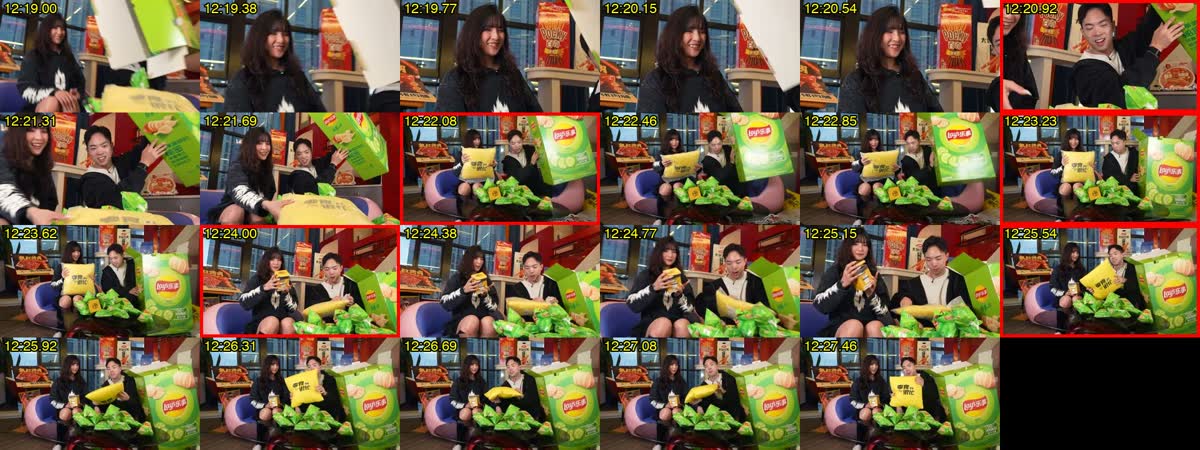
| 12:25.3 | 'Dude, they're giving us merch that no one wants' over a wide, music already dropped at 12:25.5 (dry until 12:28.6). Three seconds earlier (12:21.8-12:23.4) Amy is happily hugging the yellow pillow, but that shot is not reused. | At the end of 'no one wants' (~12:27.0) cut 0.8 s to Amy hugging the pillow and smiling (lift 12:22.0-12:22.8), keep it dry, then cut back to the wide and let the music re-enter at 12:28.6 as now. The line says nobody wants it; the picture shows she does. | Footage already in the cut (12:21.8-12:23.4). No asset. Showing the same shot twice hits our no-repeat rule (law AO), so this needs another angle or take, or your OK on reuse. |
| 13:23.1 | 'How many people do you think this bowl will feed?' / 'Probably like 20 people.' / '20 people?' over wide 1.8 s + medium 2-shot 2.6 s + wide 1.2 s; a quiet music runs through it and through the ~1 s silent lid lift (13:27.6-13:28.6); the music only drops at 13:29.0 on 'Oh no'. | Cut the exchange as singles punched from the 13:24.9 medium 2-shot: asker 1.2 s, Amy on '20 people' 1.0 s, a tighter punch (1.3x) on '20 people?' 0.8 s. Pull the music out at 13:26.3 (on '20 people?'), not 13:29.0, so the lid lift plays 1.3-1.5 s in silence before 'Oh no, oh no'. The slam on the cup pour at 13:35.8 stays. | Footage already in the cut; punch-ins need the source above 720p (check the original resolution). Music edit only. |
9 more moments
| When | Now | What an editor would do | Needs |
|---|---|---|---|
| 14:14.0 | 'It's not that big.' / 'Yeah, it's not that big, but.' (14:14-14:16) over the stretched roll-up 2-shot (14:15.1-14:16.2); the music music runs straight through. Then Hafu stuffs the roll-up in his mouth (14:16.25) and the 0.4 s extreme close-up punch at 14:18.1. | Kill the music at 14:14.0 for the two lines. After 'but' hold the 14:15.1 2-shot 0.7 s longer (Amy's sideways look at Hafu) in silence, then slam the music back on the 14:16.25 cut where he shoves it in. The existing 14:18.1 extreme close-up punch stays. | Footage already there. Music edit only. |
| 9:18.0 | 'Yeah, cause you like eggs.' / 'The only reason I like eggs is because they have protein.' / 'I don't think this has any protein.' (9:16-9:23), all on a wide 2-shot and overhead inserts, no music (dry, good). Amy's laugh at 9:21.6 is small in the wide. | On 'any protein' (~9:22.3) drop a 0.8 s fact card over the egg ('PROTEIN: 0 g', or the real nutrition panel if it was shot), then cut to Amy's face 0.8 s (punch-in on the 9:21.4 wide) before the existing music slam on the flip at 9:22.85. Shift the flip slam 1.6 s later. | Fact card graphic (or a pack-label insert if one exists in the B-roll). Amy punch-in needs the source above 720p. A joke fact card is joke text, which our law BB bans unless you allow it (your call 2). |
| 11:16.0 | Package sword fight, 'Dead.' at 11:16; probably an added clang at 11:13.9; the music runs through. | Freeze 0.8 s on the frame after 'Dead.' (11:16.3), kill the music, slam a fighting-game 'K.O.' card with an announcer sting, then resume on 'I know what this is' (11:18). | Freeze is in-footage; 'K.O.' card + announcer SFX are new. |
| 11:41.0 | 'Do geese have necks this long?' (11:41-11:43) as Hafu holds up the long tube pack; mostly dry, music re-enters around 11:42.7 when he swings it. | Right after the question, cut 0.7 s to a stock goose stretching its neck (or a goose next to a ruler), dry, then back with the music entry at the 11:42.9 swing cut. | One stock clip (goose neck stretch). No footage change. |
| 12:59.3 | Normal-size candies come out; the music is already killed at 12:57.6 (good); 'Bro.' at 12:59 sits on a 0.8 s medium 2-shot, then the wide and 'I feel like this candy exists to just troll me' with the music back at 13:00.4. | Extend the 12:59.26 medium 2-shot to 1.4 s after 'Bro.' (Hafu staring at the tiny candy, Amy smiling beside him), keep it dry, and bring the music in on the 13:00.0 cut instead of 13:00.4. | Footage already there (needs ~0.6 s of handles in the medium shot). |
| 13:44.4 | 'I want giant noodles!' (13:42-13:44) / 'Why did I spend all this money buying a giant version?' (13:44-13:47) over wides of the cups on the table; the music from the 13:35.8 slam runs under it. | After 'buying a giant version?' (~13:47.3) cut 0.8 s to the 13:11.0 store shot (Hafu beaming with two giant buckets), music out for that 0.8 s, then cut back to the bucket close-up with the 'Total 1' graphic. Trim the 13:47.6 shot by 0.5 s to keep the length. | Footage already in the cut (13:11.0-13:14.1 store insert). Showing the same shot twice hits our no-repeat rule (law AO), so this needs another angle or take, or your OK on reuse. |
| 10:04.0 | 'This looks more like an omelet to me.' (10:04-10:06) over the overhead of the pudding lid peel; the music continues. | Hold the overhead and split-screen or wipe a 0.6 s omelet still beside the pudding on 'omelet' (or a caption 'omelet?' with a pan sizzle SFX), music hole 0.6 s under it. | Stock omelet image + SFX, or a caption template. |
| 10:10.8 | ALREADY WELL CUT: Hafu's pudding bite held 3.1 s, whip to Amy's grimace held 2.8 s, music cut at 10:12.0, 0.4 s punch-in on 'This is disgusting'. The study's hold the silent face recipe almost exactly. | Move the music drop from 10:12.0 to the whip at 10:10.8 so the whole grimace plays dry (now its first 1.2 s still has music under it). Nothing else. | Music edit only. |
| 14:01.0 | ALREADY WELL CUT: music out 14:02.5-14:04.9 under 'I actually got a lot of these big snacks for you', slam back on the cut that lands 'Too bad they're not big'. That is a clean short music cut-out + button. | Keep as is. Optional study-style variant: hold the music out 0.8 s past the zinger on the 14:05.0 2-shot (Amy smiling, Hafu laughing), then slam on the 14:07.3 cut to 'Whoa'. Test both; neither is clearly better. | Footage already there. |
What I changed in our editing system
The laws changed, but only long-form opts in. Shorts, vlogs and every other lane work exactly as before.
- Reaction law (AY): a format can now opt in to a same-scene reaction from another moment (picture only, mouth closed). The default stays same-instant. An AI ruling on October 11 had blocked this outright; your note outranks it.
- Sound law (BA): that opt-in is the one exception to "audio from one moment over picture from another". Moving dialogue onto other footage stays banned.
- Effects law (S): a gag a format sanctions now counts as a reason for a zoom or effect.
- Long-form rules: opted in on reactions, added a comedy pass, added a harder music stop for deadpan beats, and one new precedent.
- New playbook:
courses/most-expensivest.mdwith the recipes, each marked usable or blocked, read when planning a long-form edit. - Your 5 notes are in the feedback ledger, and the measurable gaps are filed as gate candidates, advisory only.
Your calls
How this was done, and what it can't prove
- All 107 playlist entries were checked; 1 is unavailable. Comments on the other 106: the top 500 by relevance plus every match for 8 editor words, 3,642 editor comments in total.
- You said about 50, however many there are, not under 20. 48 videos have 5 or more editor comments and 37 have 10 or more. Below 10 the likes fall to almost nothing, so I cut there. 2 are age-restricted and couldn't be downloaded, which left 35.
- Each episode was mined by its own helper from frames, transcript and audio measurements. An independent reviewer then re-checked about 100 quotes and like counts, 11 examples on the frames, and every meter. All reproduced.
- The audio script first had music stops and entrances swapped. Helpers caught it, it was fixed and tested, and every number here is from the corrected run. The first pilot episode was mined before the fix, so its music timings are approximate.
- Added jokes: helpers counted about 4 a minute vs about 1, but the control helpers knew their episodes were low-praise. A blind recount of 6 clips kept the direction with overlap (5, 9, 5 vs 5, 2, 0 per 3 minutes, visual gags only, one-sided p 0.08). The 2016 kittens episode ties two praised clips.
- Year: the first 5 controls were all from 2014 to 2016, and "give the editor a raise" became a comment meme later. An independent reviewer flagged that, so I added 4 low-praise episodes from 2017-2023 (2 more were age-restricted). They overlap the praised ones, which is why the headline says house style.
- Sound: nobody listened to these. Music timing comes from measured levels, and sound effect labels are guesses.